



Converting Basements into Habitable Spaces
1. Introduction
Converting basements into habitable spaces, such as a bedrooms, offices, gyms, or living areas, can significantly increase usable floor area and property value. However, basements are inherently high-risk environments due to their below-ground location, exposure to groundwater and soil moisture, and limited natural ventilation.
The long-term success of any basement conversion is determined far less by finishes and far more by how effectively waterproofing, moisture management, humidity control, mould prevention, and harmful gas mitigation (Radon, Methane, Carbon Dioxide, Sulphuric gas, etc) are addressed from the outset. Many failed conversions result from cosmetic solutions applied over fundamentally inadequate moisture control systems.
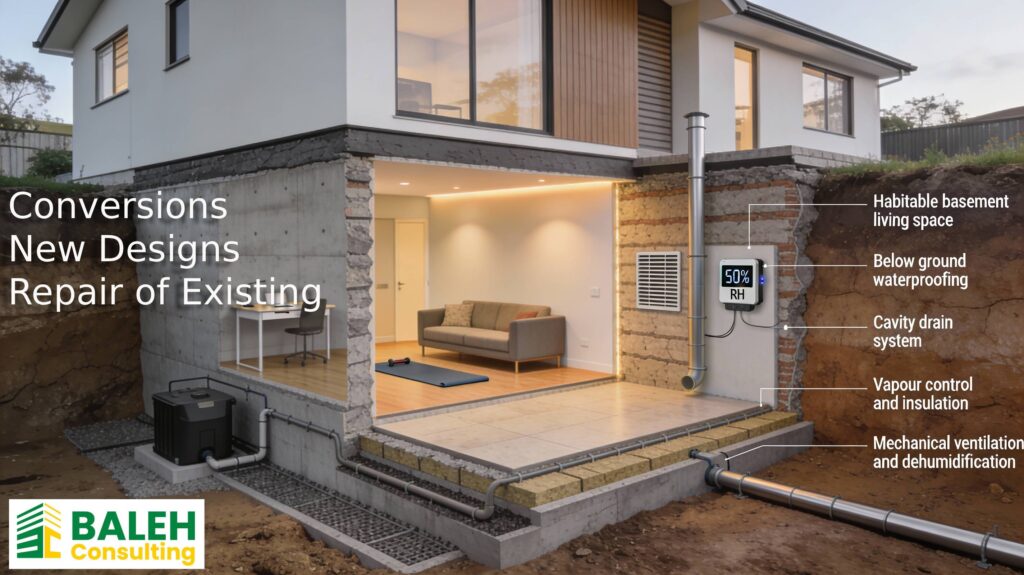
2. Basement Risk Profile
Basements are subject to conditions rarely experienced by above-ground spaces, including:
- Hydrostatic pressure and groundwater fluctuations
- Capillary moisture migration through concrete and masonry
- Construction joints and penetrations acting as water pathways
- Limited natural drying potential
Moisture problems in basements are often concealed, persistent, and progressive, making early and robust design critical.
3. Waterproofing as the Foundation of Habitability
No basement should be considered habitable unless its waterproofing system is demonstrably fit for purpose. Installing linings, insulation, or finishes over a deficient waterproofing system almost inevitably traps moisture and leads to mould, material degradation, and unhealthy indoor conditions.
Effective waterproofing must be:
- Designed, not improvised
- Continuous, with particular attention to joints and penetrations
- Maintainable, allowing future inspection and repair
4. Waterproofing Approaches
- External (Positive-Side) Systems stop water before it enters the structure and provide the highest level of protection, but are often impractical for existing buildings.
- Internal (Negative-Side) Systems, including waterproofing membranes (Type A), crystalline coatings (Type B), and cavity drain (Type C) systems, are commonly used in retrofit projects. Properly designed internal cavity drain systems manage water in a controlled and maintainable manner and are often the most reliable retrofit solution.
Construction joints, cold joints, service penetrations, and starter bars remain the most common leakage points and require specific detailing such as waterstops, injection systems, and compatible flexible seals.
There is no “one-system-that-fits-all; however, one must engage a below-ground waterproofing expert, such as Baleh Consulting, to review the site condition, assess the risks, and design an effective and durable system in accordance with BS 8102.2022 Section 4.2 “A waterproofing specialist should be appointed as part of the design team so that an integrated waterproofing solution is created ”, and in accordance with NHBC Section 5.4.3 Waterproofing “The design of waterproofing systems shall be undertaken by a suitably qualified person and be appropriate for the specific performance required”.
A wrongly designed system will cost unimaginable time and money to the client.
5. Moisture, Vapour, Harmful Gas, and Condensation Control
Even without visible leaks, basements are exposed to significant moisture loads from vapour diffusion through concrete, residual construction moisture, and occupant activities. Concrete is inherently porous and allows moisture vapour migration unless specifically treated.
Poor insulation and lining strategies frequently worsen conditions by trapping moisture or creating condensation. Best practice requires:
- Correct placement of vapour control layers
- Use of moisture-resistant insulation materials
- Continuous thermal insulation to limit cold surfaces
- Allowance for inspection and drying/breathing
- Provision of automatically activated ventilation systems with fitted sensors
Condensation risk is elevated in basements due to cooler surfaces. Managing this risk requires an integrated approach that combines insulation, ventilation, and active control of humidity and harmful gases.
6. Mould Risk and Prevention
Mould requires moisture, nutrients, and limited air movement, conditions commonly present in basements. In conversions, mould is usually a symptom of moisture failure, not a standalone issue.
Common triggers include trapped moisture behind linings, concealed leaks, and inadequate ventilation. Prevention relies on controlling moisture sources, ensuring substrates are dry before enclosure, limiting organic materials in high-risk zones, and maintaining relative humidity below approximately 60%.
7. Humidity Control and Ventilation
Natural ventilation is rarely sufficient in basements. Most habitable basement conversions require mechanical ventilation and, if necessary, dedicated dehumidification.
Effective strategies may include:
- Mechanical or balanced ventilation systems
- Heat Recovery Ventilation HRV / ERV (Energy) systems to manage air quality and energy efficiency
- Integrated dehumidification with permanent drainage
Monitoring systems such as hygrometers, sump pump alarms, and leak detection significantly improve long-term performance by allowing early intervention. Note: It is also advisable to provide dual pumps, an alarm and a battery backup system or alternatively via gravity to a suitable external drainage system.
8. Regulatory and Best-Practice Framework
In Australia, habitable basement spaces must comply with the National Construction Code (NCC) requirements for dampness, moisture management, ventilation, and indoor air quality. NCC 2022 places increased emphasis on condensation risk and moisture control.
Relevant Australian Standards commonly referenced for below-ground designs include:
- AS 3740 (internal wet areas)
- AS 3500 (Plumbing and Drainage series)
- AS 2870 (slabs, footings, and moisture behaviour)
- AS 3600 and AS 3735 for structural elements, including liquid retaining structures.
Australia does not currently have a dedicated below-ground waterproofing standard equivalent to BS 8102:2022, which is therefore widely adopted as international best practice. BS 8102 emphasises risk-based design, Grade 3 dry environments for habitable spaces, combined waterproofing systems (Types A, B, and C), and long-term maintainability.
Minimum compliance alone does not guarantee performance. Habitable basement conversions require project-specific waterproofing design, clear detailing, and independent inspection. Typically, Baleh Consulting’s designs include several layers of protection by adopting Plans A, B, and, in some critical situations, Plan C.
Various other standards, codes of practice, and technical guidelines are available around the world. To name a few, NHBC Standards, PCA, IBC, CIRIA, BCBC, etc.
9. Conclusion
Converting basements is technically demanding and unforgiving of design or construction shortcuts. Waterproofing, structural movements, concrete cracking, moisture control, humidity management, and mould prevention are the defining factors that determine whether a basement will become a healthy living space or an ongoing liability.
A performance-based approach, aligned with NCC requirements, relevant Australian Standards, and BS 8102:2022 best practice, is essential. In basement conversions, the unseen systems will always matter far more than the visible finishes.
Baleh Consulting operate Australia wide and internationally, and we are prepared to assist clients worldwide. Contact us today.
Note: It is important to note that whether designing basement waterproofing for a new build, repairing an existing basement, or converting basements into habitable spaces, the fundamental principles remain the same
Article Written by Hacène Baleh on 25/01/2026











7 Comments
Really great information can be found on web site.
This is really interesting, You’re a very skilled blogger. I have joined your feed and look forward to seeking more of your excellent post. Also, I’ve shared your site in my social networks!
I am often to blogging and i really recognize your content. The article has actually peaks my interest. I’m going to bookmark your website and maintain checking for brand new information.
Thanks for this grand post, I am glad I discovered this web site on yahoo.
As I web site possessor I believe the content material here is rattling great , appreciate it for your efforts. You should keep it up forever! Good Luck.
I am glad to be a visitor of this utter website! , regards for this rare information! .
Hello! I just would like to give a huge thumbs up for the great information you will have right here on this post. I will be coming back to your blog for extra soon.